
Bathroom Mirror Size Guide: How to Choose the Right Fit for Your Space
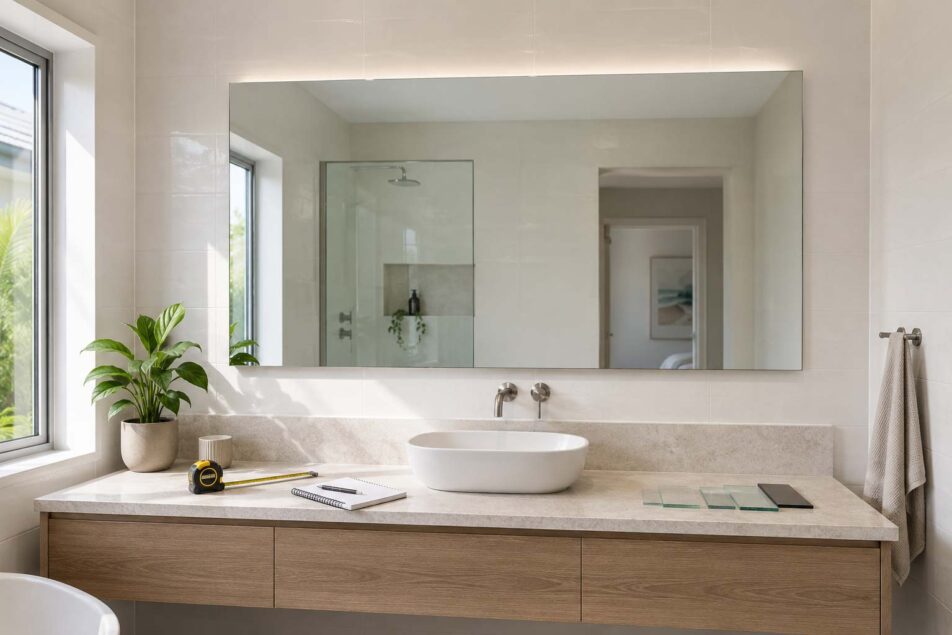
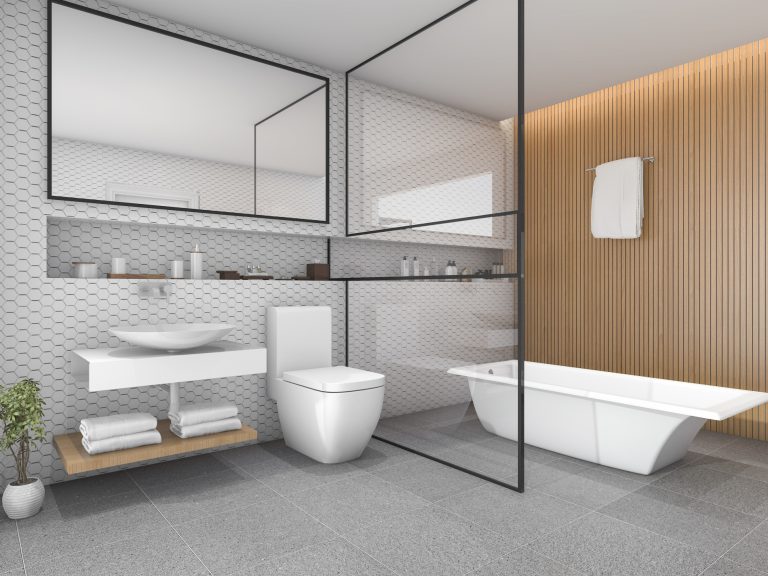
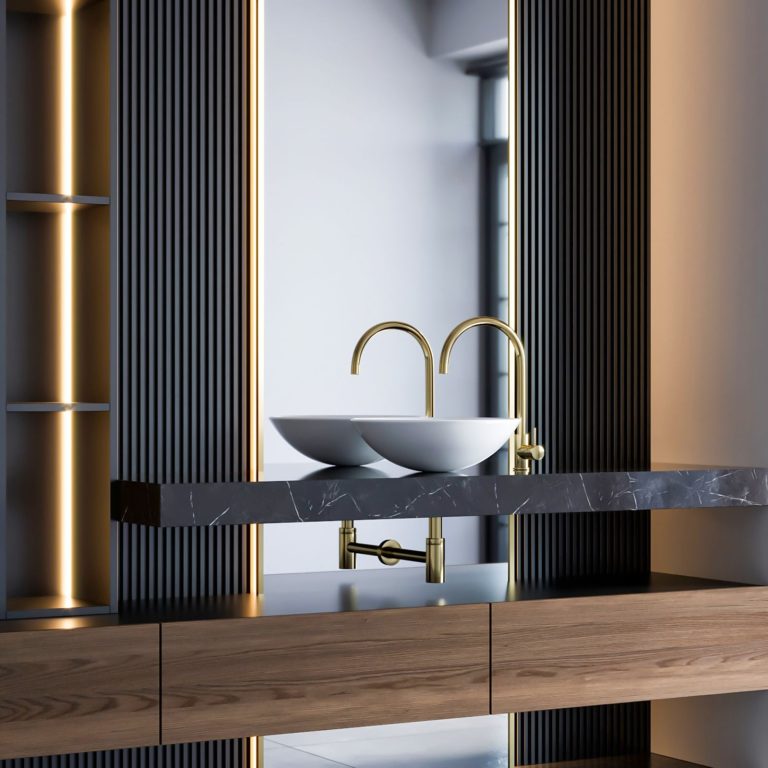
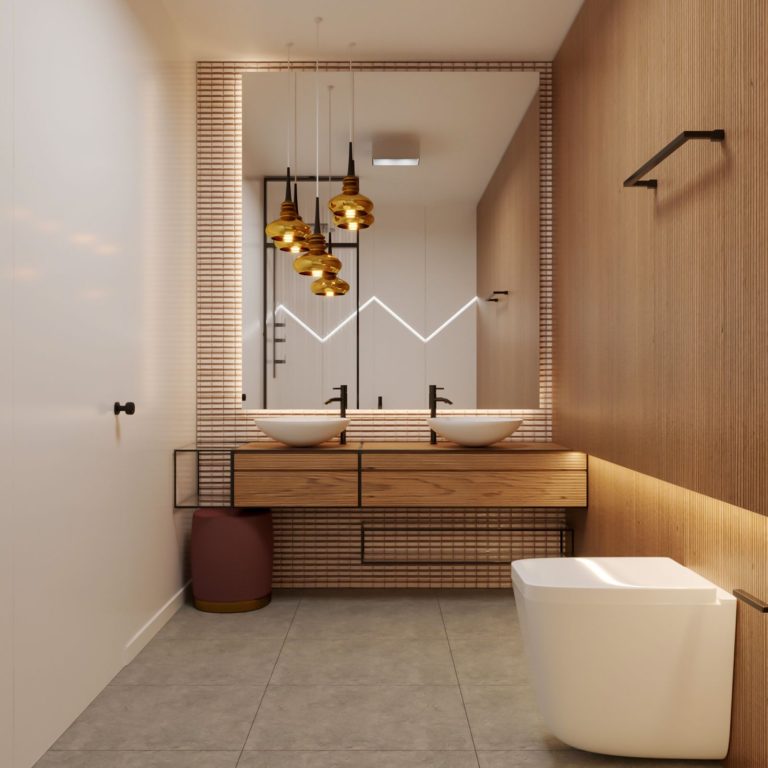
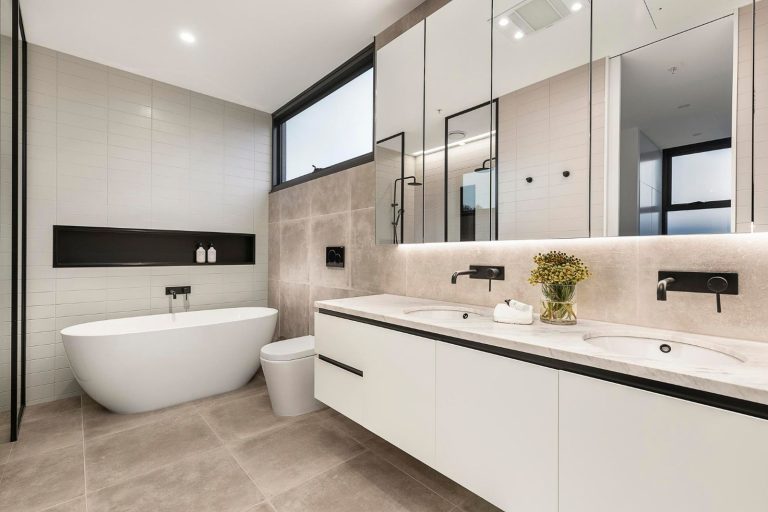
Please note: The images displayed in this blog post are for illustrative purposes only and do not reflect the REGAL Shower Screens range. Please visit the Product pages of our website for a true representation of our products.
A customer came into the showroom last month with a tape measure and a number in her head. She’d been told her vanity was 1100mm wide, so she needed a 900mm mirror — that was standard, that was the size, end of conversation. We pulled out her drawings, looked at the wall and the sconces she’d already chosen, and she walked out an hour later having ordered a 1080mm-wide frameless mirror with a polished edge, cut to span the full vanity properly.
That gap — between the size people think they need and the size that actually fits the space — is what this bathroom mirror size guide is about. It walks through the proportions that genuinely matter: how wide the mirror should be relative to the vanity, where it should sit vertically, what changes when you’ve got a double vanity or a high ceiling, and how to land on a size that suits your bathroom rather than the closest off-the-shelf option.
Every mirror we make is made-to-measure in our Gold Coast workshop, so the size you need is doable, whether it matches a common stock dimension or not. The decision you’re actually making isn’t standard versus custom. It’s what fits.
Standard Bathroom Mirror Sizes (and Why They’re Only a Starting Point)
Walk into most Australian bathroom suppliers, and you’ll see roughly four width brackets on the floor: small mirrors around 450–600mm, medium around 700–900mm, large around 1000–1200mm, and oversize or full-wall pieces above 1200mm. These are the bathroom mirror sizes most buyers compare against when they start sizing up a vanity.
| Size Label | Typical Width Range | Common Use |
| Small | 450–600mm | Powder rooms, narrow ensuites |
| Medium | 700–900mm | Single vanities up to 900mm wide |
| Large | 1000–1200mm | Wider single vanities, larger ensuites |
| Oversize / Full-Wall | 1200mm+ | Double vanities, feature walls, main bathrooms |
Here’s a useful thing to know: there’s no Australian standard that mandates them. No code. No regulation. They exist because they’re convenient to cut, pack, transport and stock — manufacturing brackets, not design rules.
This matters because they only work when your vanity, wall and ceiling happen to suit them. The most common comment I hear in the showroom is some version of “my vanity is 1080mm and the closest size is 1000 or 1200 — which do I round to?” The honest answer is neither, because rounding to fit a stock size is solving the wrong problem. We cut every mirror in 4–6mm glass to whatever bathroom mirror dimensions the space actually calls for, up to 2400mm as a single piece (larger jobs are segmented). The stock brackets are a useful reference. They aren’t the menu — and settling for an off-the-shelf size to suit a wall it wasn’t cut for almost always shows.
How to Choose the Right Vanity Mirror Size
This is the part most buyers come looking for. The rule worth starting with is straightforward: a vanity mirror is usually slightly narrower than the vanity itself — by around 50–100mm on each side — so the mirror sits within the vanity’s footprint visually. When the edges of the mirror line up cleanly inside the edges of the vanity, the whole arrangement looks intentional. When the mirror sits wider than the vanity, it tends to look like an afterthought, unless the design is deliberately running mirror full-wall.
That’s the rule. Here’s where it stops being useful.
Feature splashbacks that wrap around the basin eat into the available width. Sconces and wall lights need clearance you can’t always negotiate. Double vanities introduce a one-mirror-or-two question that single vanities don’t have. And in older homes around the Gold Coast, walls that aren’t quite square change what “centred” even means. Knowing how to choose a bathroom mirror size means treating the proportional rule as a starting point and reading the wall in front of you.
Width gets most of the attention, but it’s only half the answer. Mirror height is the dimension people forget. The vanity mirror dimensions worth thinking about cover the vertical space between the splashback (or vanity top) and the ceiling — enough mirror to feel proportionate to the vanity width, with breathing room above and below. The most common on-site moment I have is walking a customer through the height side of vanity mirror size after they’ve already locked in the width and assumed the job was done. It almost never is.
For help thinking through frame, finish and style alongside dimensions, our guide to choosing the right bathroom mirror covers the selection side in depth — this section stays focused on size.
Sizing Examples by Vanity Width
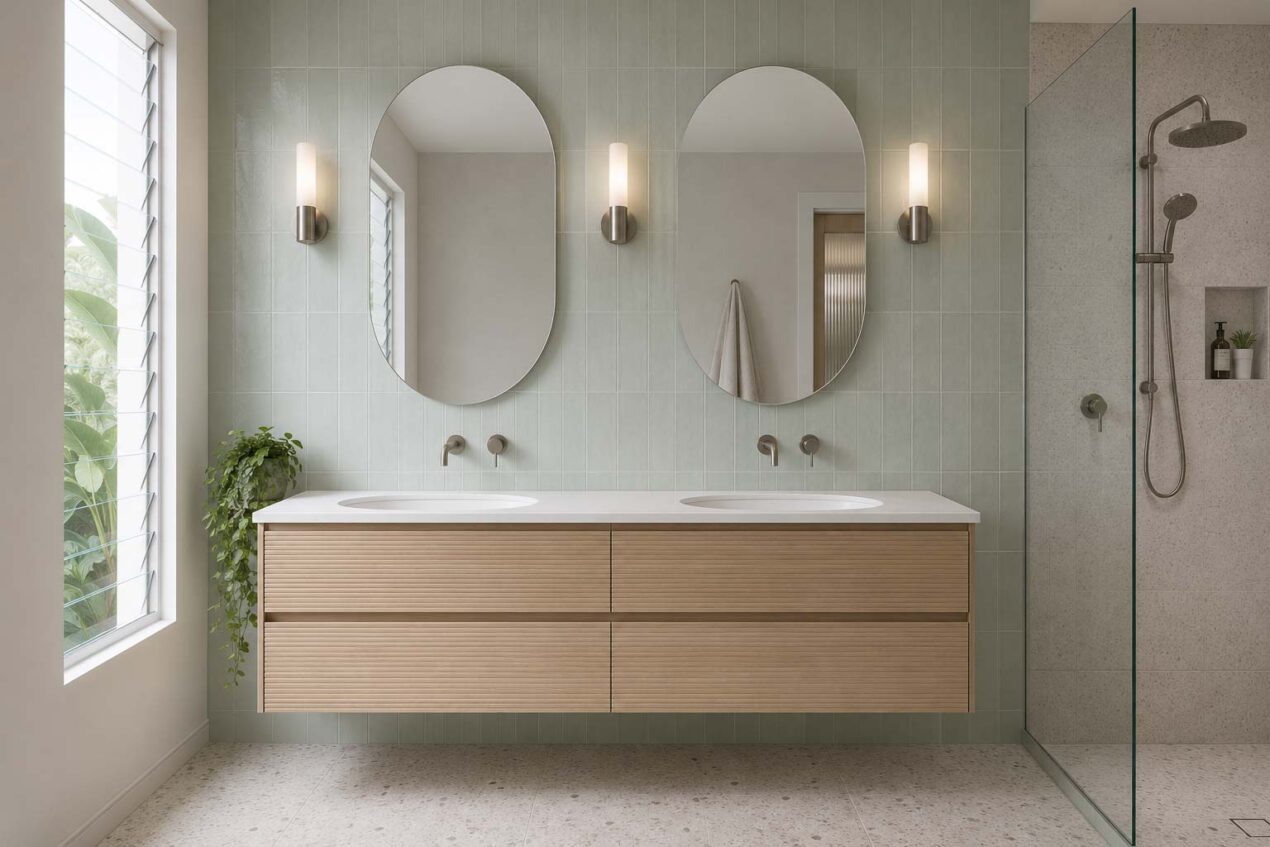
These are starting ranges drawn from how vanities actually sit on Australian walls, not fixed rules. Ceiling height, splashback design and tapware all shift the right number.
| Vanity Width | Recommended Mirror Width Range | Notes |
| 600mm | 500–600mm | Powder rooms, narrow ensuites |
| 750mm | 650–750mm | Single vanity, smaller ensuite |
| 900mm | 800–900mm | Most common single vanity in Australian bathrooms |
| 1200mm | 1080–1200mm (one mirror) or 2 × 500–550mm above twin basins | Single basin or twin basin layout |
| 1500–1800mm | 1400–1700mm (one mirror) or 2 × 600–700mm above twin basins | Double vanity — one wide mirror or two |
A common question we get is what size mirror for a 900mm vanity — somewhere in the 800–900mm width range, depending on whether you’ve got sconces, a feature splashback, or a tapware setup that wants extra reveal. The other one we hear constantly is what size mirror for a 1200mm vanity, and that one really is a fork in the road: one wider mirror around 1080–1200mm if it’s a single basin, or two individual mirrors above twin basins if the layout has them. Neither is wrong. The answer depends on the basin configuration and the look you’re after.
Worth saying once: these ranges aren’t gaps between stock options. Every mirror in our range is cut to the millimetre, so a 1080mm or 1340mm mirror size for a vanity is just as available as a 900mm.
Bathroom Mirror Height and Ceiling Clearance
This wouldn’t be much of a bathroom mirror size guide without covering the vertical dimension — and it’s where most generic guides go quiet.
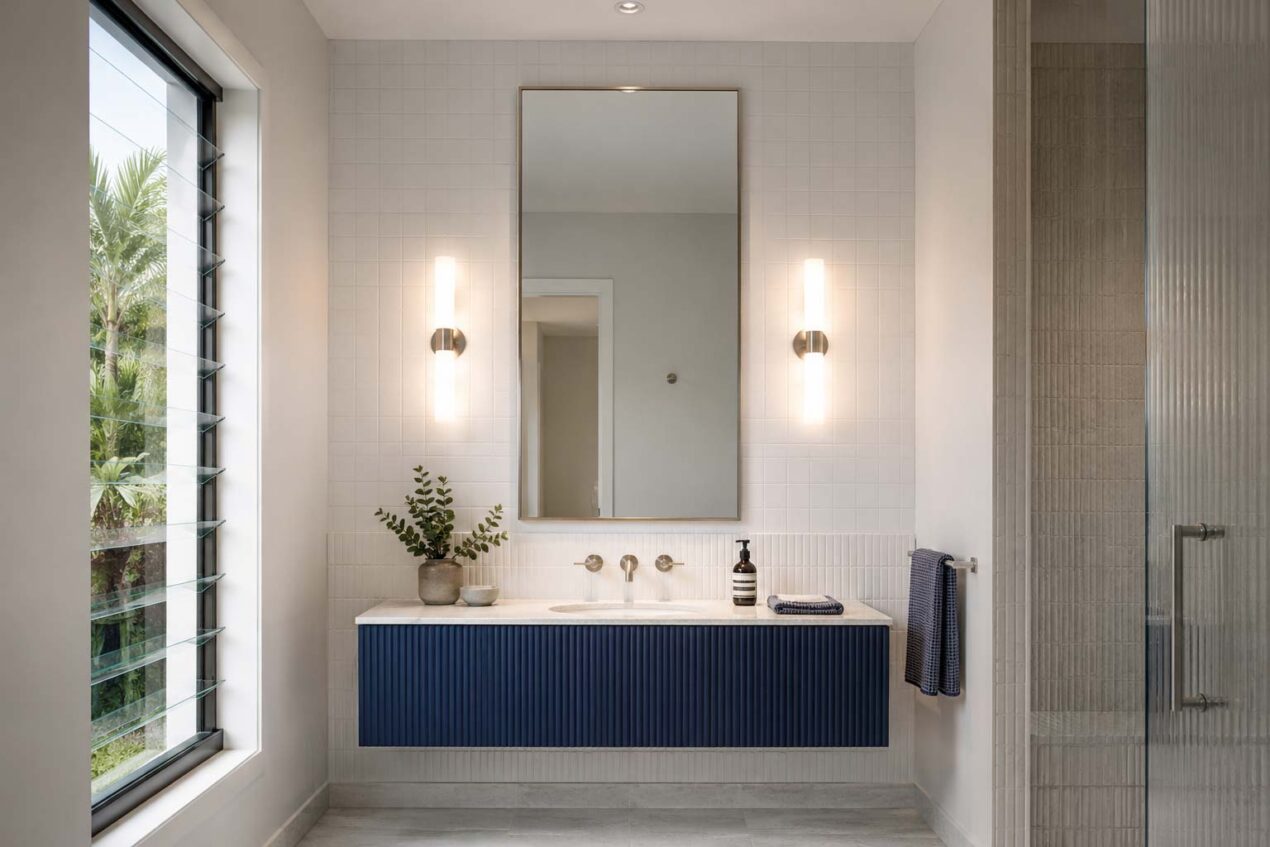
The bottom edge of the mirror should sit just above the splashback or backsplash, with a small reveal between the two. The reveal gives silicone, tapware spouts and the top edge of the splashback room to sit cleanly beneath the mirror line, rather than crashing into it. How much reveal depends on splashback height, vanity height, and whether the tapware is wall-mounted or sitting on the basin — there’s no universal number that works across every bathroom.
The top edge wants breathing room from the ceiling. Around 100–200mm is a useful starting figure, but ceiling height changes the conversation completely. A standard 2.4m ceiling, a new-build 2.55m, and a raked or 2.7m+ ceiling each call for a different vertical proportion. Taller ceilings can carry a taller mirror, but they also reward leaving more clearance up top so the mirror reads as deliberately placed rather than stretched to the roof.
Eye level is the third piece. The centre of the mirror should sit roughly at the eye level of the people who use the bathroom most often — but user height, vanity height and how the room is laid out all shift where that lands. This is why we don’t recommend a universal install height. Every bathroom is different, and we measure on-site.
A few things change the maths further. Sconces or wall lights flanking the mirror need clearance on both sides and above. Mirror cabinets — recessed or surface-mounted — bring their own depth and frame considerations that affect how the mirror sits relative to the wall. Wall-mounted tapware shifts the bottom reveal because the spout comes through the splashback, not up from the basin.
This is the part of the job that most buyers benefit from a free on-site measure for. We come out, take the dimensions off the actual wall, factor in the splashback, sconces, tapware and ceiling, and the mirror gets cut and installed to suit — once, properly, the first time.
Mirror Sizes for Powder Rooms, Ensuites and Main Bathrooms
The proportional rules shift depending on which bathroom you’re sizing for. A powder room mirror works on a different logic than an ensuite vanity, and a main bathroom feature wall is a different conversation again.
Powder rooms lean decorative. The mirror is a visual statement first and a functional reflection second, because the room is small and the use is brief. Sizing the mirror smaller than the vanity is fine — sometimes preferable. This is where feature shapes earn their keep: an arch, an oval, or a round mirror sized to a 600mm vanity reads more like a piece of joinery than a utility fitting. Width-to-vanity ratio matters less than how the shape sits on the wall.
Ensuites are functional-first. Most ensuite vanities are single, sized somewhere between 750mm and 900mm wide, with one person using the mirror at a time. The standard width logic applies — 50–100mm narrower per side than the vanity — and sconce clearance becomes important quickly because ensuites are often tighter on wall space than main bathrooms. The job is a clean, well-proportioned mirror that does its job without crowding the rest of the room.
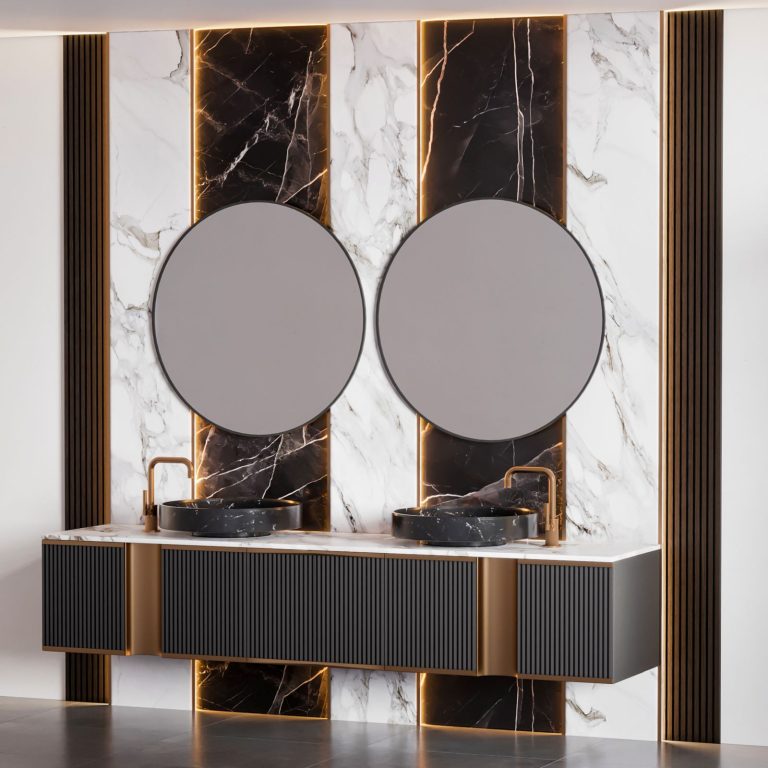
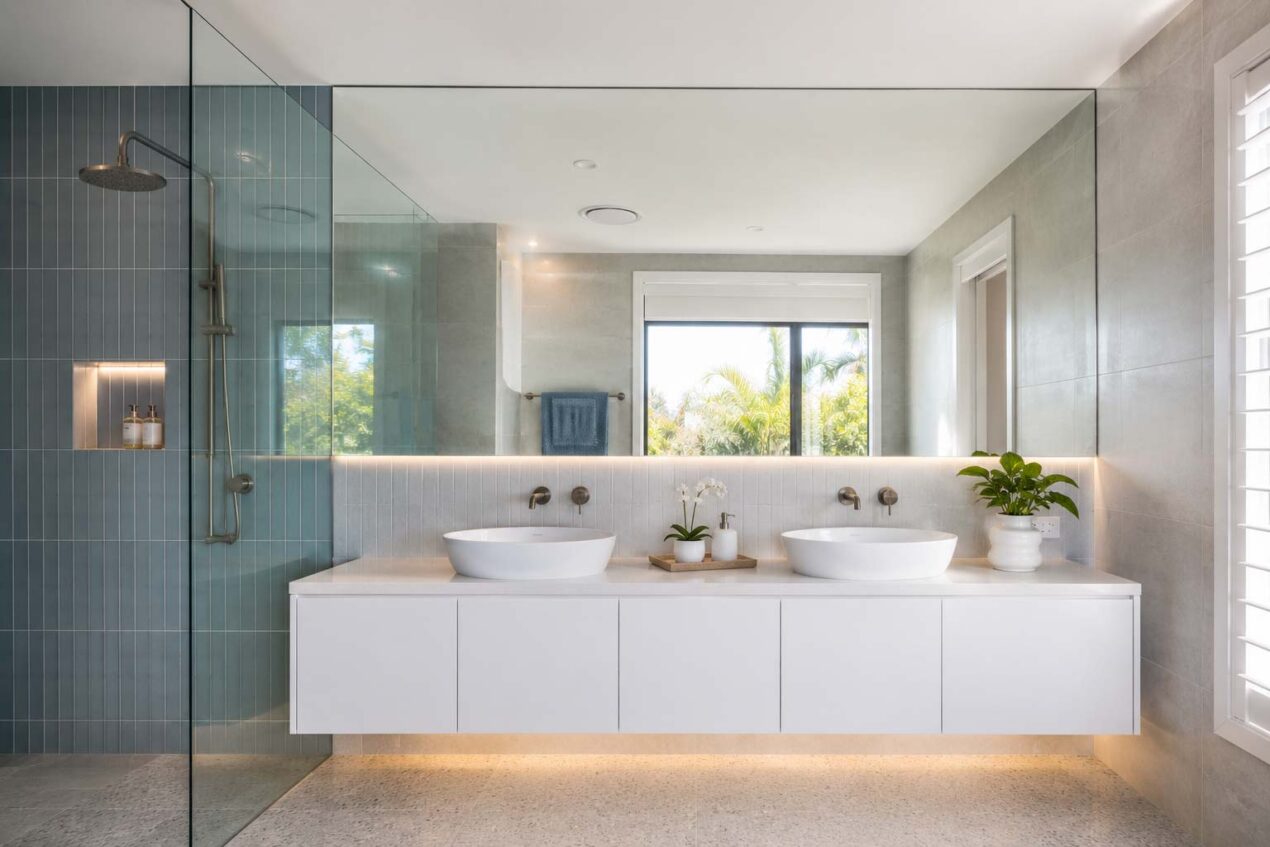
Main bathrooms are where the one-mirror-or-two question genuinely matters. Double vanities with twin basins can run a single wide mirror across the whole vanity, or sit two individual mirrors above each basin. Both work. The single-mirror look reads more architectural and tends to make the room feel wider; two mirrors give each user a defined space and play better with symmetrical sconce arrangements. Frameless gives more flexibility on width here — we can run a frameless mirror to 2400mm as a single piece, where framed mirrors stay in square or rectangle profiles only.
Feature walls are where custom sizing matters most. A full-wall or near-full-wall mirror is the strongest tool for making a small bathroom feel bigger, but stock sizes almost never fit cleanly against the actual wall — there’s always a gap, a column, or a stud that wants the mirror cut to suit. The application that surprises customers most on-site is this one: people assume a feature wall mirror means a “big mirror” and don’t realise until we measure that the dimensions they need don’t appear on any supplier’s stock list. They never have. They’re the wall.
Framed vs Frameless: How Size Affects Your Options
Sizing doesn’t sit on its own. The frame and edge decisions interact with it, and once you know what shape you’re after, the path through the size question often clarifies itself.
Framed mirrors come in a 6mm aluminium frame or a slimmer micro-frame profile, and they sit in square or rectangular proportions only — that’s the geometry the frame can carry cleanly. The frame is available in six colours: White, Black, Polished Silver, Matt Silver, Satin Gold and Nickel. If you’re matching the mirror to tapware or hardware finishes, this is the side of the range that gives you that flexibility, and the sizing logic stays close to the proportional rules already covered — vanity-aligned width, balanced height.
Frameless mirrors open up shape and size at the same time. You can choose between a polished edge or a bevelled edge, and the shape range goes well beyond rectangle: arch, pill, round, oval, curved corners and organic free-form profiles all sit in frameless territory. The glass itself is Grade A safety glass with a polished edge, which is the relevant Australian Standard for safety glazing in this kind of application. Frameless also supports the widest single-piece sizes — up to 2400mm — which makes it the practical choice for spanning double vanities or running a feature wall.
Customers often walk in asking about size and end up making the framed-versus-frameless decision based on the shape they want. They come in for a 1200mm mirror and leave having ordered an 1180mm arched frameless because that’s the shape that suited the wall — and at that point, the sizing flexibility comes along for free. For a deeper look at the shape options available across the range and REGAL’s custom mirror features, both of those guides go further than this article does on the non-size detail.
The takeaway is straightforward. If the shape you want is anything other than a rectangle, you’re in frameless territory and the size is genuinely flexible. If you want a coloured frame to tie into your tapware or hardware, you’re in framed territory and the size sits in rectangular proportions. Neither is more or less custom — both come off the same workshop bench, cut to your dimensions.
When to Choose a Custom Bathroom Mirror Size
The honest recommendation across this whole guide is the same one we’d give in the showroom. Every mirror in our range is made-to-measure in our Gold Coast workshop, so a 900mm width is no different from a 1080mm width in terms of what we can supply. The decision worth making is what suits the space — not which size category to pick.
That said, there are situations where a non-standard size isn’t just an option, it’s clearly the right answer. Vanities that don’t sit at a common width — 1080mm, 1350mm and similar — almost always look better with a mirror cut to suit rather than a stock width that misses by 50mm or more. Feature splashbacks that wrap the basin limit where the mirror can land vertically and horizontally, and the cleanest result usually means cutting to the available reveal rather than working backwards from a stocked dimension. Taller ceilings reward a taller mirror. Lower ceilings need the maths run in reverse. A full-wall application on a single wall almost never aligns to a stock size cleanly. And double vanities call for either a wide single piece sized to span the two basins or two precisely matched mirrors above each — neither of which tends to come off a shelf.
The size, shape and finish are all separate decisions. A standard 900mm width with an arch top is straightforward. A stock-sized rectangle in a frame colour that ties into your tapware is straightforward. A frameless oval cut to fit a 1450mm-wide niche is straightforward. They all come off the same workshop bench.
Our process is built to take the guesswork out. We start with a free on-site measure across the Gold Coast — we come to you, take the dimensions off the actual wall, factor in splashback, sconces, tapware and ceiling, and confirm the mirror size, shape and finish that suits the room. The mirror is then cut and toughened locally in our Gold Coast workshop, and our own team handles the install — no subcontractors, no handoffs. Mirrors come with a 1-year warranty.
If you’re at the dimension stage of your renovation and want to see the full range, our made-to-measure bathroom mirrors cover frame, frameless, shape and finish options across the Gold Coast.
Frequently Asked Questions About Bathroom Mirror Sizing
How Big Should a Mirror Be Over a Bathroom Vanity?
A bathroom mirror over a vanity is usually slightly narrower than the vanity itself — often 50–100mm in from each edge — so the mirror sits visually within the vanity’s footprint and reads as intentional. The right size depends on vanity width, ceiling height, and whether you have a feature splashback or sconces that need clearance. Because we cut every mirror to order, the exact width is set by the vanity and the wall, not the closest stocked dimension.
What Size Mirror Should I Get for a 900mm Vanity?
For a 900mm vanity, a mirror around 800–900mm wide usually works best — slightly narrower than the vanity, or matched to its width, depending on the bathroom layout and any sconces flanking it. Height comes down to ceiling clearance and where the splashback ends. Most ensuites with a 2.4m ceiling suit a mirror somewhere between 700–900mm tall, though a free on-site measure removes the guesswork.
What Size Mirror Should I Get for a 1200mm Vanity?
For a 1200mm vanity, there are two good options. A single wide mirror around 1080–1200mm gives a clean, continuous look across the vanity. Two narrower mirrors of around 500–550mm each work better above true double-basin vanities, where each user has their own defined zone. Both options work in framed or frameless, and any size in that range is buildable in our workshop.
Are There Standard Bathroom Mirror Sizes in Australia?
There’s no Australian standard that mandates specific bathroom mirror sizes. The common stocked widths — small (450–600mm), medium (700–900mm), large (1000–1200mm) and oversize (1200mm+) — exist because they’re convenient to manufacture and ship, not because they’re required. Custom sizes are cut to fit the wall, and for non-standard vanities, taller or lower ceilings, or feature splashbacks, a custom mirror is usually the better fit.
Choosing the Right Bathroom Mirror Size for Your Space
The whole point of this bathroom mirror sizing guide is to help you choose by what suits your space, not by what’s on a stock list. Standard sizes are a useful starting reference. Vanity-to-mirror proportions give you the width logic. Height and clearance fill in the vertical half of the decision. Bathroom type — powder room, ensuite, main bathroom, feature wall — shifts the rules slightly. And once you bring frame and edge into it, the size, shape and finish all become independent choices rather than a package deal.
The recommendation we’d give in the showroom is the same one this article has been building to: pick the size that fits the wall, the vanity and the room. Because every mirror is cut to order in our Gold Coast workshop, that size is what we make.
Book a free on-site measure with the REGAL team and we’ll size your bathroom mirror to the wall, not the other way around — backed by 50+ years of family experience across the business and a 1-year mirror warranty.
Request a Free Quote Today!
Experience the REGAL difference today by completing the free quote request form below. Your dream space awaits.