
Glass Splashback Cost on the Gold Coast: 2026 Pricing Guide
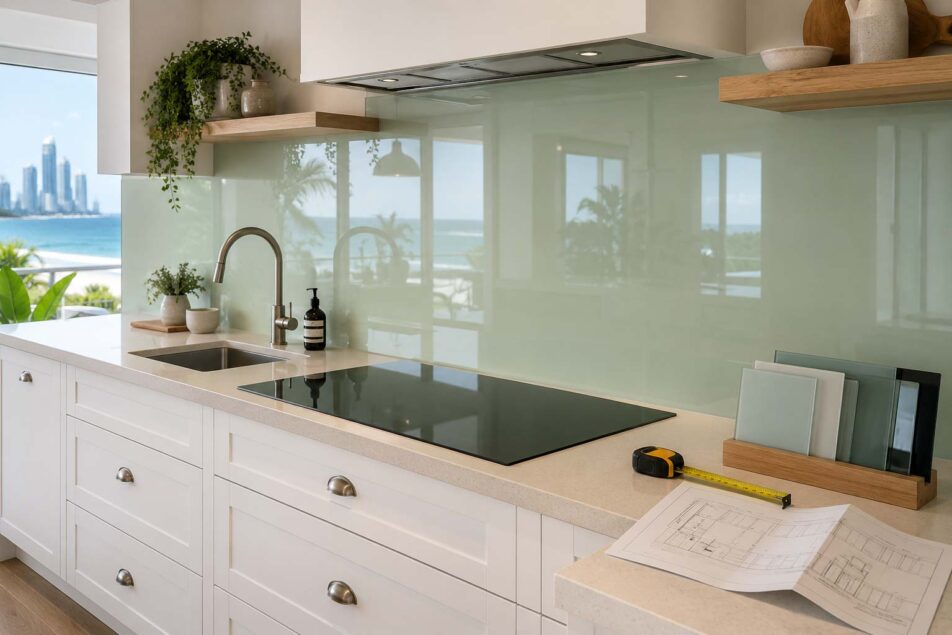
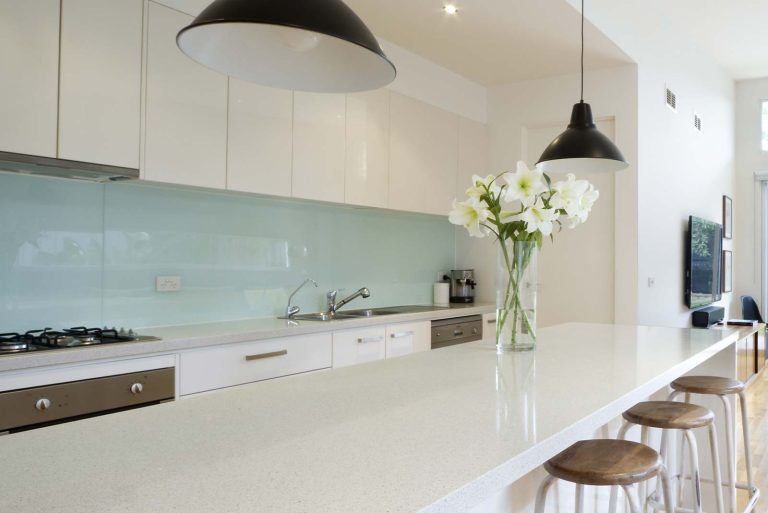
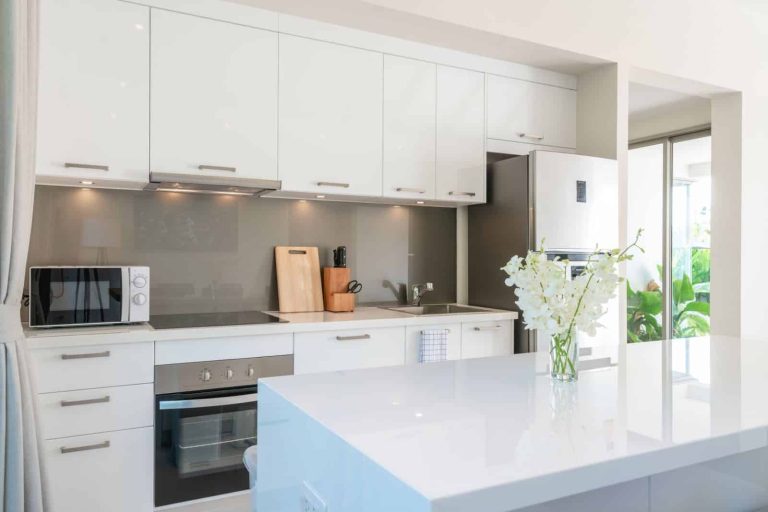
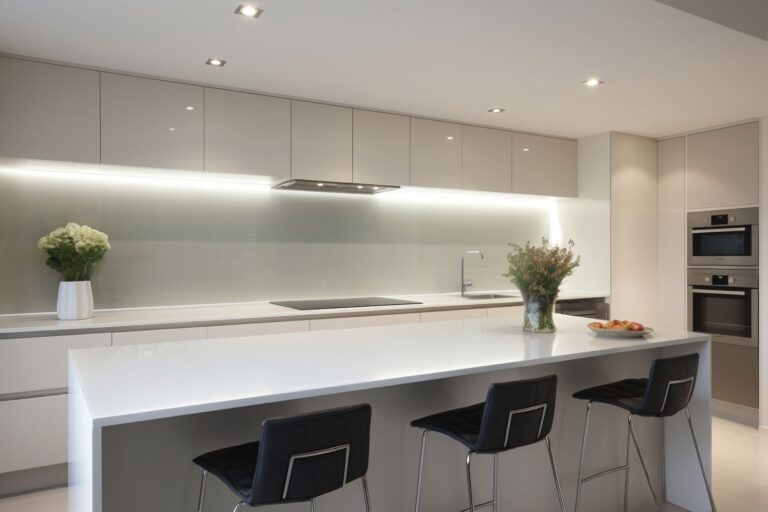
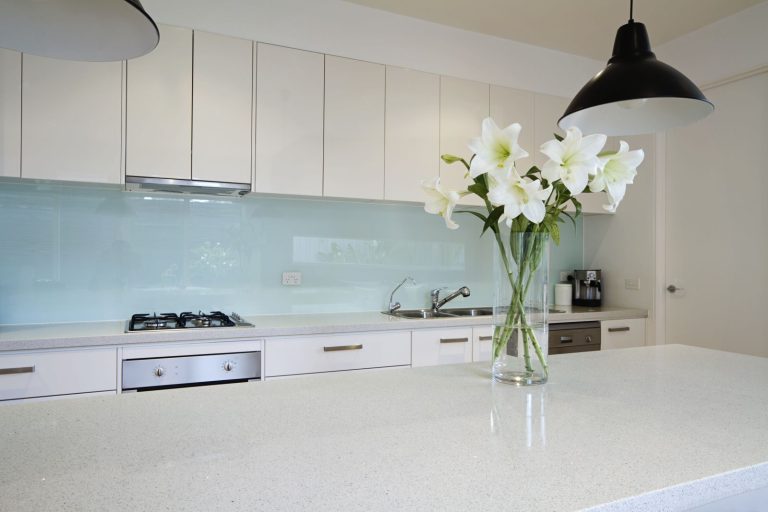
Please note: The images displayed in this blog post are for illustrative purposes only and do not reflect the REGAL Shower Screens range. Please visit the Product pages of our website for a true representation of our products.
Glass splashback cost on the Gold Coast starts from around $1,200 supply and install for back-painted coloured glass on a 1000×2000mm reference panel, with MirrorKote tinted mirror from around $1,400 and Bel Vetro marble-look glass from around $1,500. Custom printed glass is quoted per project. These are budget estimates, not quotes — every figure in this guide is the all-in price for a fitted splashback, with the on-site measure, custom-cut toughened glass, installation by our own team, and a two-year warranty included. We supply and install across the Gold Coast, Brisbane, and Tweed Heads, and the figures here are locked in by a same-day fixed quote on the day of the free measure — no per-square-metre material rates, no hourly install labour added later.
You may also see these called glass backsplashes — same product, different word. Below, you’ll find a comparison table for our glass splashback range, followed by what changes the final price, how kitchen, bathroom, and laundry projects compare, and how glass stacks up against tile and acrylic. With more than fifty years of family experience in glass and aluminium, and our own Brisbane Glass Plant cutting and toughening locally, we can usually have a fixed quote in your hands the same day. Book a free measure when you’re ready.
Glass Splashback Cost Comparison Table
Every price below is supply and install. The on-site measure, custom-cut 6mm toughened glass, installation by our own team, and a two-year warranty are included as standard across every splashback type.
Ready to order your new glass kitchen splashback?
Contact REGAL Shower Screens for a free consultation today.
| Splashback Type | Reference Panel Size | Starting From (Supply + Install) | Finish Detail |
| Back-painted coloured glass | 1000×2000mm | from around $1,200 | Locally toughened, back-painted to your chosen colour |
| Tinted mirror (MirrorKote) | 1000×2000mm | from around $1,400 | Locally toughened, MirrorKote finish in Super Silver, Smokey, or Bronze |
| Marble-look glass (Bel Vetro) | 1000×2000mm | from around $1,500 | Locally toughened, Bel Vetro marble-look print |
| Custom printed glass | Project-specific | Quoted per project | Locally toughened, your artwork printed and proofed |
Budget estimates only — not quotes. Based on a 1000×2000mm reference panel for fair comparison across finishes. Final pricing depends on splashback dimensions, glass type, the number of cut-outs (around $60 per cut for power points and switches), and site conditions. REGAL provides a free on-site measure and same-day fixed quote. All prices include supply and install — no separate installation fees, no hourly labour rates.
How Much Does a Glass Splashback Cost?
Our price ladder runs from around $1,200 supplied and installed for back-painted coloured glass on a 1000×2000mm reference panel, up to around $1,500 for Bel Vetro marble-look. Custom printed glass is quoted per project depending on artwork and panel area.
The 1000×2000mm reference panel isn’t a stock product. We use it as a fair comparison size across finishes, because real splashbacks are cut to the actual dimensions of a kitchen, bathroom, or laundry — behind a cooktop, behind a vanity, above a trough, or running the length of a benchtop. Your splashback might be smaller, larger, taller, or split across multiple panels.
If you’ve already done some research, you’ve probably seen a different pricing model: per square metre for materials plus an hourly rate for installation. Most cost guides quote splashback glass at roughly $200–$600 per m² for materials, plus $80–$120 per hour for installation labour. The math works out to roughly $600–$2,000 for a complete fitted splashback — a wide range that depends entirely on how long the install actually takes on the day. That’s how a “cheap” per-m² figure can quietly turn into a much bigger final invoice.
We do it differently. Every figure in this guide is the all-in supply-and-install total — fixed in writing on the day of the free measure, with the labour, the cut-outs, and the install built into one number. The price you sign off at the measure is the price you pay on installation day.
Glass Splashback Prices by Type
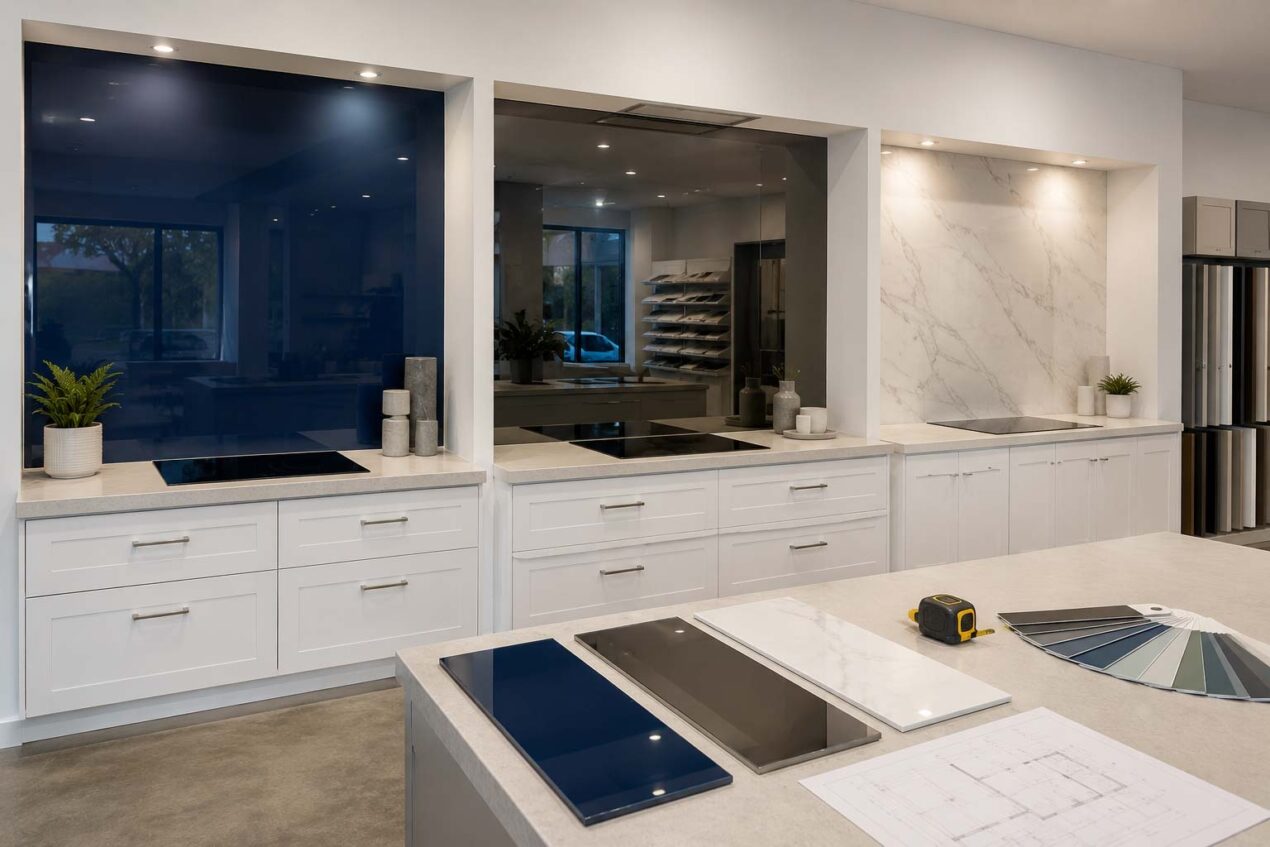
Splashback pricing climbs in clear tiers depending on the finish you choose. Here’s what each tier looks like and where each one tends to fit best.
Back-Painted Coloured Glass — From Around $1,200
This is the most popular splashback choice in Australian kitchens, and it’s where most of our quotes start. We use Opti low-iron glass for back-painted finishes, then back-paint it to any colour you specify — bring us a Dulux, Resene, or Taubmans code and we’ll match it. We recommend Opti over standard clear glass here because clear carries a faint green tint that distorts whites, pale neutrals, and soft colours; with a low-iron base, the colour you pick is the colour you see. The figure covers the measure, custom-cut and locally toughened glass, back-painting in your colour, fitting by our own team, and a two-year warranty.
Tinted Mirror (MirrorKote) — From Around $1,400
MirrorKote is toughened mirror with a tinted finish, available in Super Silver, Smokey, and Bronze. It’s reflective and warmer than a clear mirror, which is why it shows up in modern kitchens as a feature behind the cooktop and in bathrooms behind a vanity. One detail worth knowing up front: tinted mirror cost can rise on wider runs because mirror has a 2400mm single-piece maximum. Anything wider becomes a segmented run, and we plan the seam placement on the day so it lands somewhere visually quiet — usually behind a tap or appliance. Read more about our mirror splashback range if mirror is the direction you’re heading.
Marble-Look Glass (Bel Vetro) — From Around $1,500
Bel Vetro is printed glass with a marble or stone-look finish, available in patterns from soft Carrara-style veining through to darker, more dramatic stones. It gives you the look of natural stone without the weight, the cost of slab stone, the porosity, or the ongoing sealing maintenance real marble demands behind a cooktop. We see it most often in premium kitchens and as a bathroom feature wall behind a freestanding bath or vanity.
Custom Printed Glass — Quoted Per Project
Custom printed glass is genuinely project-specific, so we don’t quote a starting figure. Any image or pattern can be printed to the back of an Opti glass panel — family photos, abstract artwork, a custom kitchen design, a hospitality brand’s graphics behind a bar. Pricing depends on the artwork, the panel area, and the finish, which is why an honest figure isn’t possible without seeing the brief. It’s best used as a feature splashback in a master kitchen, restaurant, or commercial fit-out rather than a budget pick. Have a look at our custom printed glass splashbacks for examples.
What Affects the Price of a Glass Splashback?
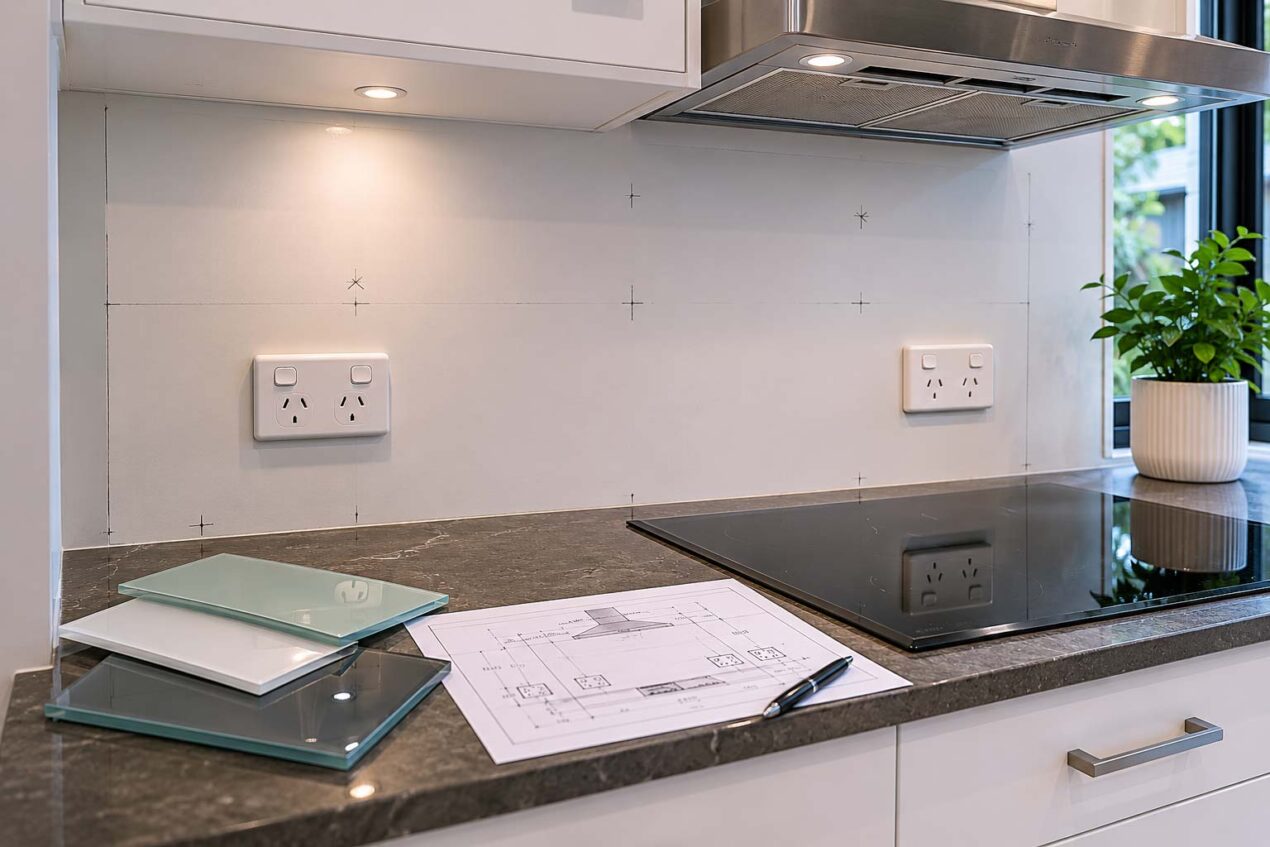
A handful of variables move the final figure up or down, all worked through during the on-site measure. Here they are, in roughly the order they matter.
Splashback Type
The splashback type sets the floor of the price ladder. Back-painted is the cheapest tier. MirrorKote sits roughly 15–20% above. Bel Vetro is a step higher again. Custom printed is project-specific and typically the most premium. The spread from cheapest to most premium is roughly 25%.
Panel Size
The 1000×2000mm reference is just that — a reference for fair comparison. Real splashback dimensions are cut to fit your actual space. A small laundry panel (often around 800×1200mm) usually comes in below the reference figure. A wider kitchen splashback — often 2400×750mm or larger across a benchtop — usually comes in above it.
Glass Specification — Standard Toughened or Opti Low-Iron
Default specification is 6mm Grade A safety glass, toughened to AS 2208. For most finishes that’s exactly what you need. For back-painted coloured glass, we recommend stepping up to Opti low-iron glass, which has minimal green tint compared to standard clear glass. The reason is colour accuracy: ordinary clear glass carries a faint green cast that quietly distorts whites, pale greys, and soft blues. Opti adds a moderate premium but is worth it for those finishes.
Cut-Outs for Power Points, Switches, and Rangehood Gaps
Each cut-out adds around $60 for a standard placement — power points, light switches, isolators, exhaust fan openings. Awkward cuts (angled openings, oversized cuts, fixtures clustered close together) cost a bit more. A typical kitchen has four to six cut-outs, a typical laundry has one or two, and a bathroom often has none. Rangehood gaps are factored into the panel layout rather than as a cut-out, but where a rangehood sits low and the panel needs to break around it, that’s worked through at the measure.
Colour and Finish Selection
MirrorKote is available in Super Silver, Smokey, or Bronze. Back-painted coloured glass can be matched to any custom paint colour — bring us a Dulux, Resene, or Taubmans code and we’ll print to match. Specific Bel Vetro patterns may add a small premium depending on print complexity.
Single Panel vs Segmented Runs
Mirror has a 2400mm single-piece maximum, so any run wider than that becomes segmented. Each segment adds a small amount of material processing and install complexity. For runs over 2400mm, we plan seam placement at the measure so the join sits somewhere visually quiet — usually behind a tap, an appliance, or a cabinet line.
Site Access and Wall Preparation
Out-of-square walls, second-storey installs, narrow access for moving large panels, rangehood positioning, and the condition of the existing wall all affect installation time and complexity. The fixed quote already accounts for all of this. For more on what to think through before you buy, our complete glass splashback buying guide covers the full picture.
Cost by Application — Kitchen, Bathroom, and Laundry
Most cost articles online treat splashbacks as a kitchen-only product, but the reality is more varied — bathrooms and laundries make up a real share of the work we quote. Each application has its own context, splashback type, and cut-out count.
Kitchen Splashback Cost
The kitchen is the most common application. A typical install runs along the benchtop and behind the cooktop, with a rangehood gap cut into the panel. Power point cut-outs are the main variable — four to six is common. Back-painted coloured glass and MirrorKote are the most popular choices, and which of the two suits usually comes down to the cabinetry and the light in the room, which is what our kitchen splashback ideas by style work through finish by finish. Bel Vetro tends to appear in premium kitchens where the splashback is the visual centrepiece, often paired with stone benchtops. Because kitchens often run wider than the reference panel and carry the most cut-outs, kitchen splashback price tends to sit at or above the starting figures in the table above.
Bathroom Splashback Cost
A bathroom splashback usually sits behind the vanity or appears as a feature wall behind a freestanding bath. Panels tend to be smaller than a kitchen splashback, and the wet-area context means the specification needs to account for moisture both in the glass and how it’s sealed. Mirror and back-painted glass dominate here, with mirror in particular bouncing light into a smaller bathroom. Cut-outs are often zero — power points usually sit on the vanity rather than in the splashback area. Smaller panels and fewer cut-outs mean bathroom price often comes in below the kitchen reference, though feature walls behind a bath can run higher.
Laundry Splashback Cost
The laundry is the simplest of the three. The standard install is a single panel above the trough, with one or two cut-outs for the washing machine and dryer outlet. Back-painted coloured glass is the usual choice — a clean white or pale grey trough splashback does the job neatly. Laundry cost is usually the lowest of the three applications because the panel is smaller and the cut-outs are fewer.
Why a Fixed Quote Beats Per-Square-Metre Pricing
If you’ve spent any time researching glass splashback cost online, you’ve almost certainly seen the same pricing model: a per-square-metre rate for materials, plus an hourly rate for installation. Material rates typically sit at $200–$600 per square metre depending on the finish, with installers charging $80–$120 per hour over two to six hours of labour. It looks straightforward on paper. The problem is what happens when you do the math.
A worked example. Take a 2m² panel of back-painted coloured glass at $300 per metre — that’s $600 in glass. Add four hours of install at $100 per hour and you’re at $1,000 all in. Reasonable. But the install could run two hours if the wall is square and the cut-outs are clean — that’s $800. Or it could run six hours if the wall is out of square, the rangehood gap is tighter than the rough-in suggested, or there’s an unexpected fixture in the way — that’s $1,200. Same job, same materials, same panel size. The total swings by 50% depending on how the install goes on the day.
Per-m² plus hourly install isn’t really a price. It’s a range with no certainty, and you don’t know where you’ll land until the installer packs up.
I had a customer come to me last year with exactly this problem. She’d had a quote elsewhere for her kitchen splashback — what looked like a reasonable per-metre rate plus “about three hours” of labour, so she’d budgeted around $1,000. Three hours turned into nearly six because the wall was out of square behind the cabinetry and the rangehood gap was tighter than the original rough-in suggested. Her final bill was almost double what she’d planned for. A few weeks later we measured the same job, handed her a fixed all-in price on the spot, and that’s exactly what she paid when we installed.
That’s the model we work to across our range. One number, written down on the day, with the supply, the cut-outs, the install time, and the awkward bits already factored in. $1,200 is $1,200 — not “between $800 and $1,400 depending on how the labour goes.”
To be fair to the per-m² model, it does work in the right situation: a simple square wall, no cut-outs, easy access, and a reliable install estimate. That’s a small share of real jobs. Most Gold Coast and Brisbane homes — older properties, rangehood gaps, four to six power points, walls that aren’t quite plumb — are where the fixed all-in price gives you a much more useful number to work with.
If that sounds like your project, book a free measure and we’ll work through the variables and hand you a fixed quote on the day.
Glass Splashback vs Tile and Acrylic — What’s the Real Cost Difference?
Glass isn’t the only splashback material on the market, and pretending it always wins doesn’t help anyone make a decision. Here’s an honest comparison across the three most common alternatives — tile, acrylic, and natural stone.
Glass Splashback vs Tile Splashback
Tiles win on Day 1, and glass usually wins over the long run. Tile materials typically run $30–$50 per square metre — a fraction of any glass tier. Where the picture changes is over time. Tiles need grout, and grout stains, harbours mould in humid Queensland kitchens, and dates the look as design trends move on. A glass splashback is a single piece with no grout lines, which makes it easier to clean, more durable in wet kitchens, and cheaper to live with year to year. Over a 10-year horizon, total cost of ownership often lands in glass’s favour. Tiles still win when the upfront budget is genuinely tight, or when the design specifically calls for a tiled finish glass can’t replicate. For more on this trade-off, the pros and cons of glass splashbacks goes deeper.
Glass Splashback vs Acrylic Splashback
Acrylic costs roughly half the price of glass and is lighter to install. The trade-offs are real, though. Acrylic scratches easily, yellows over time (especially behind sunny windows), doesn’t handle direct heat from a gas cooktop, and looks plastic up close. Where it works: rentals, short-term renos, splashback positions away from a heat source. Where it doesn’t: behind a gas cooktop where AS 1288 and AS 2208 glass safety standards apply, or in any kitchen where the homeowner is staying long-term.
Glass Splashback vs Stone or Marble Splashback
Natural stone is often double or more the materials price of glass — and that’s before the heavier installation, the structural support some panels need, and the ongoing sealing maintenance natural slabs demand behind a cooktop. Marble is the most extreme example: a slab runs into serious money, and marble is famously porous, which means regular sealing to keep oil and acid splashes from staining. Bel Vetro printed glass is our answer — the look of marble without the porosity, the weight handling, or the sealing schedule. Stone wins when you specifically want the unique veining of a real natural slab and the budget supports it. Bel Vetro wins on cost, maintenance, and visual consistency from one panel to the next.
Australian Standards and Glass Splashback Safety
Glass splashback safety in Australia isn’t a marketing claim — it’s regulated. Every splashback we install has to meet specific safety standards, and the figures in this guide reflect properly compliant glass.
All glass splashbacks in Australia must be Grade A safety glass, which means the glass is toughened so that if it ever fails, it breaks into small, blunt pieces rather than dangerous shards. Two standards govern this. AS 1288:2021 covers glass specification and fitting in human-impact areas, which includes any splashback behind a cooktop. AS 2208:2023 covers the toughening and testing requirements for Grade A safety glass. Both are referenced in the National Construction Code, and both apply to every splashback we install.
We use 6mm Grade A toughened glass as standard, cut and toughened locally in our Brisbane Glass Plant. The 6mm thickness gives the right balance of strength, optical clarity, and weight for kitchen, bathroom, and laundry installations.
In Queensland, glass splashback installation falls under the Glass, Glazing and Aluminium licence administered by the QBCC. Our installers hold the relevant licensing, and you can verify any installer’s licence — ours or anyone else’s — through the QBCC public register before you book.
Why does this matter in a cost article? Glass specification is one of the corners cheaper supply-only or DIY quotes can quietly cut. Thinner glass, glass that hasn’t been properly toughened, or imported panels that don’t carry AS 2208 certification can all show up in the same per-square-metre price band as a properly compliant panel. The figures here reflect 6mm Grade A safety glass, toughened to AS 2208, specified and fitted to AS 1288 — the standard you’d want behind your cooktop.
Why Local, Australian-Made Matters
REGAL is a Gold Coast family business with more than fifty years of family experience in glass and aluminium. The “Australian-made” claim isn’t a slogan — it’s how the panels actually get to your wall.
Every splashback we supply is cut, processed, and locally toughened in our Brisbane Glass Plant. The panels aren’t imported pre-cut. The cut-outs for power points and rangehood gaps are made in the same plant by the same business measuring and installing the splashback. From there, most panels move to our Nerang factory for finishing. Where any framing or trim work is involved, we use Australian-made aluminium and hardware. Installation is handled across the Gold Coast, Brisbane, and Tweed Heads by our own team — not subcontractors. The two-year warranty is backed by the same business that measured, made, and fitted the panel.
Why does local manufacturing matter for a custom-made splashback? Cut-outs. A power point opening that’s 2mm off-centre is the difference between a clean fit and a botched install. When the cut-outs are made by the same factory that’s installing the panel, that error margin stays tight. With imported pre-cut glass or supply-only panels from interstate, there’s no recovery if a measurement shifts.
A few months back we had a kitchen install where the electrician moved a power point about 80mm to the left the day before installation, to clear a new appliance the homeowner had decided on late. With most suppliers, a change like that means pushing the install a week or two while a new panel is cut and shipped from interstate. Because our glass is cut and toughened in Brisbane, we had a re-cut panel back at the Nerang factory by lunchtime the next day, and the kitchen was finished on schedule. That kind of turnaround is what a local manufacturer can do — an imported supply chain genuinely can’t.
For Brisbane and Tweed Heads homeowners: the same Brisbane Glass Plant, the same Nerang factory, and the same install team service every job. Distance from the manufacturing site doesn’t change the splashbacks you receive, the spec, or the warranty.
Getting a Quote for a Glass Splashback on the Gold Coast
If the figures here line up with your budget, the next step is a free on-site measure. Here’s exactly what happens once you book one — no commitment, no obligation to proceed.
- Step 1 — the free on-site measure. We come to your home, take precise dimensions, measure for every cut-out (power points, switches, rangehood gaps, isolators), and walk you through your glass type, finish, and colour options. It usually takes 30–45 minutes.
- Step 2 — the same-day fixed quote. Before we leave, you’ll have a written quote with a single all-in figure. The variables (panel size, cut-outs, finish, site access) have all been resolved at the measure, so the figure stays fixed from there.
- Step 3 — manufacturing. Once you’re happy with the quote, the glass is cut and toughened in our Brisbane Glass Plant, then back-painted, MirrorKote-finished, or Bel Vetro-printed at the Nerang factory. Manufacturing turnaround is typically within a week.
- Step 4 — splashback installation. We schedule the install directly with you once the panel is ready. It’s handled by our own team. For more detail, what to expect from a glass splashback installation walks through the install day end to end.
We service the Gold Coast, Brisbane, and Tweed Heads — same team, same fixed-quote model. The measure is genuinely free and booking one doesn’t commit you to anything.
Book a free measure when you’re ready.
Frequently Asked Questions
How Much Does a Glass Splashback Cost on the Gold Coast?
Glass splashbacks on the Gold Coast cost from around $1,200 supply and install for back-painted coloured glass on a 1000×2000mm reference panel. MirrorKote tinted mirror starts from around $1,400, and Bel Vetro marble-look from around $1,500. Custom printed glass is quoted per project. Final pricing depends on splashback dimensions, the number of cut-outs, and glass specification.
What Is the Average Cost of a Glass Splashback in Australia?
The average cost of a glass splashback in Australia is roughly $1,000–$2,000 supply and install for a typical kitchen-sized panel, depending on glass type, finish, and the number of cut-outs. Online cost guides often quote $200–$600 per square metre for materials with separate hourly install labour, which leaves the homeowner doing the math. We quote a fixed all-in figure on the day of the measure.
How Much Is a Glass Splashback per Square Metre?
Online cost guides typically quote glass splashbacks at $200–$600 per square metre for materials only, plus hourly install labour at $80–$120 per hour. We don’t quote that way. We give a fixed all-in supply-and-install figure on the day of the measure, so you have one number that doesn’t change. For most kitchens, the all-in figure works out to around $1,200–$1,500 for a back-painted coloured glass or MirrorKote panel.
How Much Does a Kitchen Splashback Cost?
A kitchen glass splashback on the Gold Coast typically sits at or above the starting figures in this guide for a standard 1000×2000mm panel with the usual four to six power point cut-outs and a rangehood gap. Back-painted coloured glass and MirrorKote tinted mirror are the most popular kitchen choices. Bel Vetro marble-look sits at the higher end of the price ladder.
How Much Does a Bathroom Splashback Cost?
A bathroom glass splashback usually comes in below the kitchen reference, because panels tend to be smaller and cut-outs are often zero. Bathroom splashbacks usually sit behind the vanity or as a feature wall behind the bath. Mirror and back-painted glass are the most common bathroom choices. Pricing depends on panel size, glass specification, and whether the splashback is a smaller vanity panel or a larger feature wall.
How Much Does a Mirror Splashback Cost?
A tinted mirror (MirrorKote) splashback costs from around $1,400 supply and install on a 1000×2000mm reference panel. MirrorKote is available in Super Silver, Smokey, or Bronze. Mirror has a single-piece maximum of 2400mm — wider runs are segmented for the best result, with seam placement designed at the measure so the join sits in a visually quiet position.
How Much Does a Glass Backsplash Cost?
In Australia, “glass backsplash” usually refers to a glass splashback — same product, different word. A glass backsplash costs from around $1,200 supply and install for back-painted coloured glass on a 1000×2000mm panel, scaling to around $1,500 for marble-look (Bel Vetro) finishes. US figures differ from Australian ones because of glass specification standards and labour rates, so the figures here apply specifically to Australia.
Is a Glass Splashback Cheaper Than Tiles?
Tiles are usually cheaper than glass on Day 1 — tile materials run $30–$50 per square metre versus higher figures for glass. The picture changes over a 10-year horizon. Glass has no grout to stain, regrout, or treat for mould, and a single glass panel typically outlasts a tiled splashback through one or two design refreshes. For most kitchens, tiles win on upfront budget; glass wins on long-term cost of ownership.
Are Installation Costs Included in the Price?
Yes — every figure quoted in this guide is the supply-and-install total, with no separate installation fees, no hourly labour rates, and no add-on charges on installation day. We don’t offer supply-only or install-only options. The on-site measure produces a same-day fixed quote that includes the glass, the cut-outs, the finish, the toughening, the fitting, and a two-year warranty.
Why Are Some Online Splashback Quotes So Much Cheaper?
Online quotes can look cheaper because they often cover materials only, then add hourly install labour separately, then exclude cut-outs and wall preparation. A $200 per square metre quote sounds reasonable until you add four to six hours of install at $80–$120 per hour, plus four to six cut-outs at around $60 each. The all-in total typically lands within the $1,000–$2,000 range for a complete fitted splashback.
Glass Splashback or Acrylic — What’s the Difference?
Acrylic splashbacks cost roughly half the price of glass and are lighter to install, but they scratch, can yellow over time, don’t handle direct heat from gas cooktops, and look plastic up close. Glass is more expensive upfront, but it holds up to heat, doesn’t scratch as easily, and meets AS 1288 and AS 2208 safety standards required behind gas cooktops. Acrylic suits rentals and low-budget renovations. Glass suits long-term homes and kitchens with gas cooktops.
How Much Does It Cost to Install Power Point Cut-Outs?
Standard power point and light switch cut-outs cost around $60 per cut. A typical kitchen has four to six cut-outs (cooktop power, rangehood isolator, bench-level power points, and a switch or two). Awkward configurations — angled cuts, oversized openings, fixtures in tight clusters — cost a bit more. The on-site measure identifies every cut-out, and the price for all of them is included in the same-day fixed quote.
Can I Get a Fixed Quote Before Installation?
Yes — we provide a same-day fixed quote on the day of the free on-site measure. That figure is the price you pay on installation day, with no estimates that change later, no surprise extras, and no hourly labour clock running. If anything genuinely changes during the project — a layout decision you make after the measure, for example — we’ll discuss it transparently before any work begins.
Does a Glass Splashback Installer Need to Be Licensed in Queensland?
In Queensland, glass splashback installation falls under the Glass, Glazing and Aluminium licence administered by the QBCC. Homeowners can verify any installer’s licence through the QBCC public register before booking. Our installers are qualified and licensed, and we work to AS 1288:2021 and AS 2208:2023 — the standards that govern glass specification and safety glazing for splashbacks behind cooktops.
Do You Offer Supply-Only Glass Splashbacks?
No — we don’t offer supply-only or install-only glass splashbacks. Every splashback we make is supplied and installed by our own team across the Gold Coast, Brisbane, and Tweed Heads. The supply-and-install model is what allows us to provide a same-day fixed quote: the same business measures, manufactures, and installs, so the price doesn’t change between quote and installation.
Get a Fixed Quote on Your Glass Splashback
Whether you’re after back-painted coloured glass, a MirrorKote feature behind the cooktop, or a Bel Vetro marble-look in a premium kitchen, the path from here is the same. A free on-site measure, a same-day fixed quote with the panel size, glass type, finish, and cut-outs all factored in, and a single figure that doesn’t change between quote and installation. The glass is cut and toughened in our Brisbane Glass Plant, finished at the Nerang factory, and installed by our own team across the Gold Coast, Brisbane, and Tweed Heads — every splashback backed by a two-year warranty.
Request a same-day fixed quote when you’re ready, and we’ll be in touch to book the measure.
Request a Free Quote Today!
Experience the REGAL difference today by completing the free quote request form below. Your dream space awaits.